

The mechanics behind a stable pallet: why optimal load security lies in the details
As a packaging specialist, we see it every day in practice: pallets being stabilised ‘by feel’. This often results in over-packaging, such as metres of unnecessary stretch film, or worse, costly transport damage. But what really is the secret to a stable load? The answer does not lie in using more material, but in finding the exact optimum between the load, the materials and the packaging technique.
Stability is not the same as ‘rigidity’
There is a persistent misconception that a pallet needs to be wrapped as tightly and rigidly as possible to completely eliminate movement. Or that more wraps automatically mean more stability. Nothing could be further from the truth. It is all about finding the sweet spot through the right combination and correct use of materials. The goal is to properly absorb the forces a pallet load is exposed to during transport.

During transport, a pallet is subjected to a complex combination of forces:
- Horizontal forces: During sudden braking, acceleration, cornering or evasive manoeuvres, the load naturally wants to shift horizontally. In the worst-case scenario, this can cause the pallet load to collapse.
- Vertical forces: Vibrations and uneven road surfaces create additional pressure on the lower packaging layers during transport. This can cause the bottom boxes to dent or tear, resulting in an unstable stack.
Optimal load security therefore focuses on finding the exact tipping point at which forces are absorbed as effectively as possible, ensuring the load remains intact even under the harshest transport conditions.
Variables: no two pallets are the same
To reach that optimal point, a considerable number of variables must be taken into account. The type of load fully determines which stabilisation technique is required:
- Weight and size: Are you dealing with light or heavy packaging, large or small formats, or a mix of both?
- Stacking pattern: Is the pallet loaded uniformly with one type of box, or is it a complex mixed load?
- Substance: Are you transporting a solid product or a liquid load that continues to move during transport?
- Material: Does the load consist of boxes, bags, buckets or trays? And are you stacking cardboard on cardboard, or plastic on plastic?
- Load-bearing capacity: Does the product itself provide structural strength, or does the outer packaging need to withstand all forces?
“Every variable within a load requires a specific mechanical counterforce. While one pallet may only need a paper anti-slip sheet between the layers to solve horizontal friction, a mixed pallet may require a plastic anti-slip sheet instead.” — Luc Coomans, end-of-line packaging specialist Belgium
Smart applications: the right friction and protection
Stretch film should, of course, always be wrapped tightly around the pallet. But the key to reducing material use and maximising grip lies in the smart use of additional stabilisation techniques. By reinforcing the core of the load, significantly fewer wraps are ultimately required.
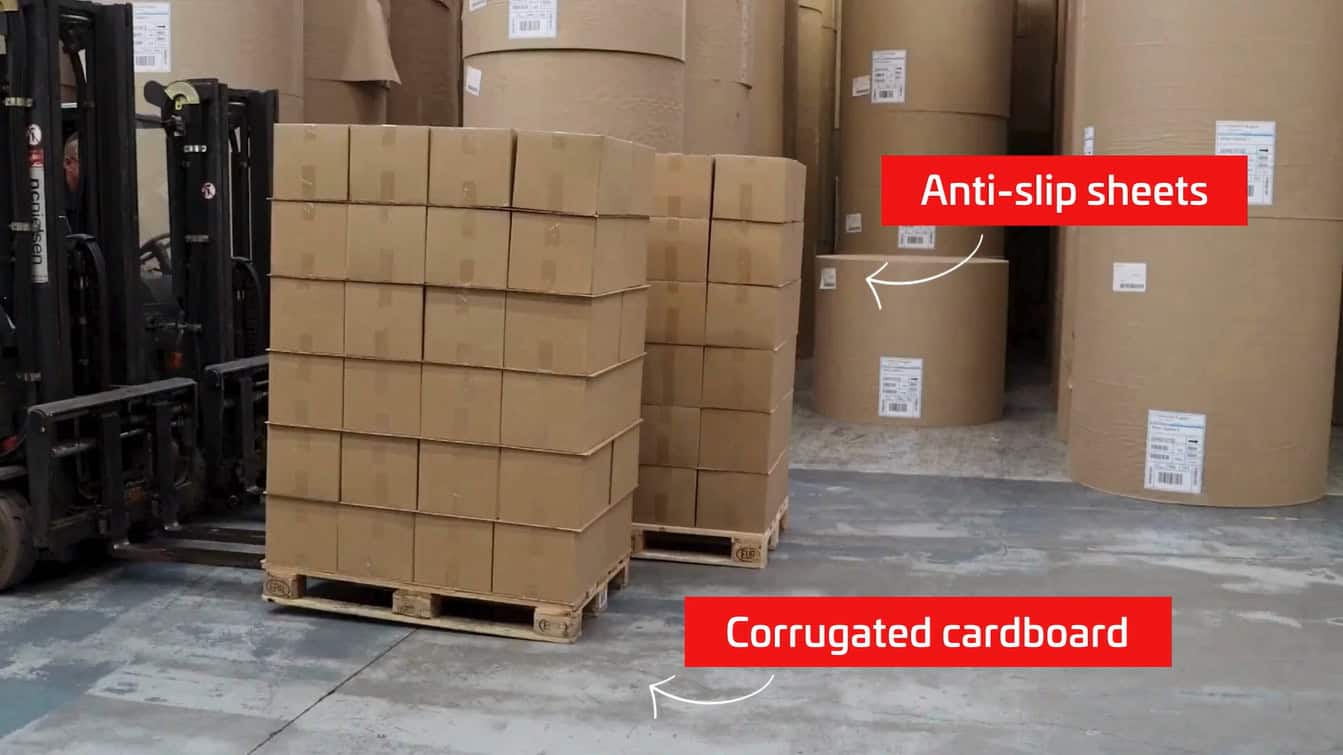
Materials that help achieve this include:
- Anti-slip sheets: Our thin paper or plastic anti-slip sheets offer extremely high friction resistance. Used as layer pads, they prevent smooth and/or uneven packaging from shifting horizontally.
- Pallet sheets: Pallet sheets provide stability as a base layer, distribute weight as interlayer sheets, and offer protection during strapping and stacking when used as top sheets.
- Edge protectors: These protect vulnerable edges and add extra vertical structure to the outer sides of the pallet. In essence, they form the ideal skeleton for your load.
- Strapping bands: Perfect for heavy-duty applications. They securely fix heavy, tall or irregular loads to the pallet.
Measuring means knowing: testing with hard data
So how can you be certain your pallet configuration will survive the journey? At the Topa Institute, we leave assumptions and gut feeling behind. We test packaging solutions based on hard, objective data.
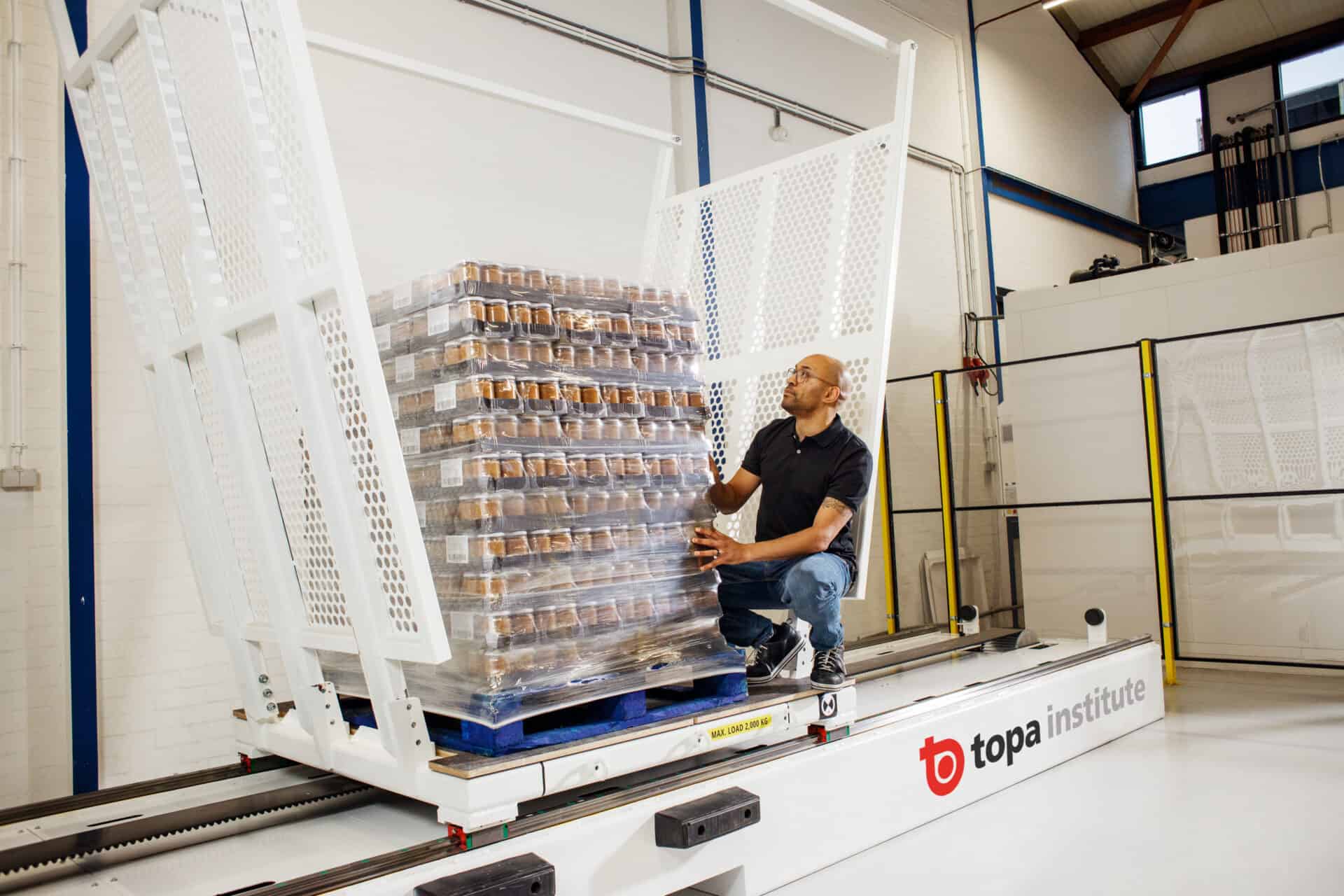
Using advanced acceleration tests, vibration tests and shock tests, we simulate the most extreme transport conditions. We can also assess how pallets perform under various climate conditions, such as fluctuating temperatures and humidity. This data shows exactly where the margins lie: can one wrap of film be removed if a specific edge protector or anti-slip sheet is added? This is how we achieve the perfect balance.
“Our expertise does not stop in the test laboratory. We also visit your site to optimise stretch wrapping machines directly on the shop floor. By perfectly fine-tuning machine parameters and testing innovative alternative stretch films, we immediately achieve substantial material savings and higher load security in practice.” — Richard Assenbroek, end-of-line packaging specialist Netherlands
Get the most out of your logistics process
Load stability is all about mastering the fine margins. With the right combination of materials and techniques, you increase control over transport safety while simultaneously reducing total costs and material waste.
Curious how we can optimise your specific pallet load? Our specialists are happy to analyse your current process. Contact us today.
You stabilise it with Topa.
Topa
Contact